Quick Answer
Traditional SEO targets exact-match keywords and accumulates backlinks by volume. Semantic SEO focuses on meaning, context, search intent, and topical authority — the signals that AI-powered search engines now use to generate answers. In 2026, neither approach works well in isolation. The businesses winning are combining both, with semantic depth doing the heavy lifting.
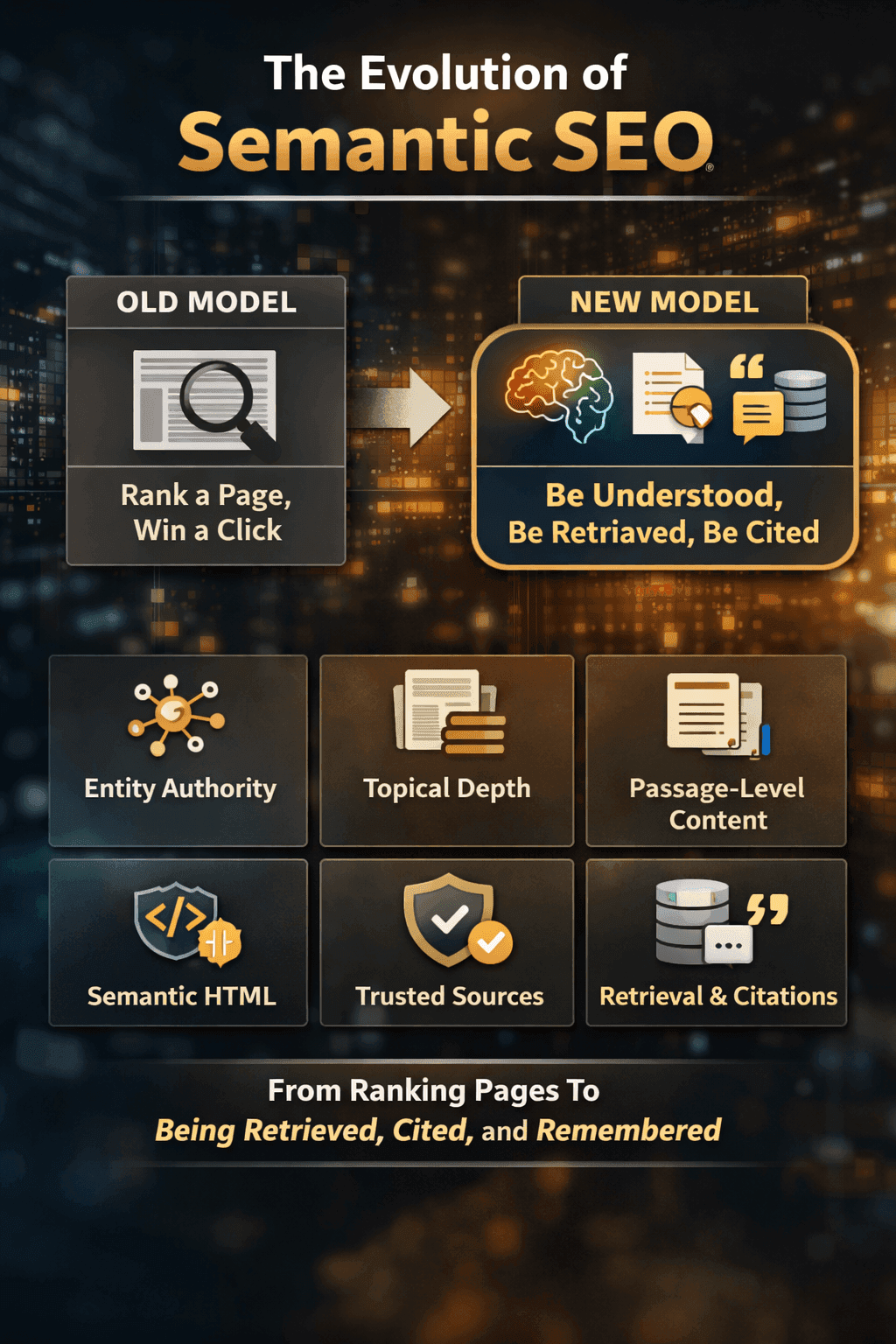
Key Takeaways
Traditional SEO built rankings on keyword density, exact-match targeting, and backlink quantity. Those tactics are now necessary but no longer sufficient.
Semantic SEO teaches search engines what you mean, not just what words you used.
Google's AI Overviews, Perplexity, and Bing AI rank sources by topical authority and contextual relevance, not keyword repetition.
The shift from "strings to things" means search engines now understand entities and relationships, not just matching text.
Topic clusters outperform siloed keyword pages because they signal comprehensive expertise across a subject.
Backlink quality and contextual relevance now matter more than raw link count.
South African businesses can use semantic strategies to outrank larger national competitors on local entity searches.
The best 2026 SEO strategy blends technical fundamentals with semantic depth (clusters, schema, intent mapping).
AI search tools cite sources that demonstrate a connected semantic content network, not just a single optimised page.
What Traditional SEO Got Right (and Why It No Longer Works Alone)
Traditional SEO established the foundations that still matter: clean site structure, descriptive title tags, crawlable pages, and inbound links that signal authority. These fundamentals have not become irrelevant — they have become the floor, not the ceiling.
The core logic was straightforward. Search engines were relatively simple pattern-matchers. If a page contained the phrase "best accounting software Cape Town" enough times and had enough links pointing to it, it ranked. That worked because the technology behind search was built on keyword strings — literal text matching between a query and a page.
Where the model started breaking down:
Keyword stuffing created pages that ranked but delivered poor user experiences.
Backlink farms gamed authority signals with low-quality, irrelevant links.
Siloed content meant every keyword got its own page — thin, repetitive sites with no coherent topical depth.
Volume over value rewarded publishing frequency rather than genuine expertise.
Google's Helpful Content Updates were a direct response. They introduced a filter that rewards pages demonstrating real subject-matter depth over pages that simply repeat a keyword at the right density.
The key insight: Traditional SEO told search engines what topic you were targeting. Semantic SEO tells them why you are the best source on that topic.
For South African businesses that built their digital presence on keyword-heavy pages and directory backlinks, this shift explains why rankings that held steady for years have started slipping since late 2024.
What Semantic SEO Actually Means
Semantic SEO is the practice of optimising content around meaning, context, and topical relationships rather than isolated keyword phrases. It aligns your content strategy with how modern AI-powered search engines actually process language. For a deeper definition, see what semantic SEO is and how to apply it.
The underlying technology shift is significant. Models like Google's BERT and MUM do not scan pages for keyword frequency. They analyse relationships between concepts, identify entities (people, places, products, ideas), and assess whether a source demonstrates comprehensive understanding of a topic.
Entities vs. Keywords
Keyword
A string of text: "heat pump installation".
Entity
A concept with attributes and relationships: heat pump connected to installation cost, energy efficiency ratings, HVAC contractors, and home renovation.
When a user searches "how much does it cost to install a heat pump," a semantic search engine does not just look for pages containing those exact words. It looks for sources that have established authority across the entire heat pump topic cluster.
Practical example: A Cape Town HVAC company that publishes a pillar page on heat pumps, supported by cluster pages on installation costs, maintenance schedules, energy savings calculations, and comparison guides, will outperform a competitor with one keyword-optimised page — even if that competitor has more backlinks.
Context vs. Volume
Traditional SEO prized search volume as the primary metric for keyword selection. Semantic SEO reframes this: a cluster of lower-volume, contextually related queries often delivers more qualified traffic and better conversion than a single high-volume keyword. The reason is intent coverage — addressing multiple related questions captures users at every stage of their research, not just the broadest entry point.
Authority vs. Backlinks
Backlinks still matter. But the signal has shifted from how many to how relevant and contextually appropriate. A single backlink from an authoritative industry publication that references your expertise on a specific topic carries more semantic weight than fifty links from unrelated directories.
How the Helpful Content Updates Changed the Rules
Google's Helpful Content Updates, rolled out progressively from 2022 through 2025, function as a site-wide quality filter. A site with a significant proportion of thin, low-value, or AI-generated-without-expertise content receives a sitewide signal reduction — meaning even its good pages rank lower. The updates effectively operationalised semantic principles at the algorithm level.
| Old ranking signal | New ranking signal |
|---|---|
| Keyword density on page | Topical coverage across site |
| Number of backlinks | Relevance and authority of backlinks |
| Word count per page | Depth and accuracy of information |
| Exact-match anchor text | Contextual entity relationships |
| Page-level optimisation | Site-level topical authority |
NLP models (BERT for query context, MUM for multi-modal and complex queries) now assess whether content was created to genuinely help a specific audience or to manipulate rankings. Pages that answer a question completely, address related follow-up questions, and connect to a broader knowledge structure perform significantly better. The content audit is now a strategic exercise in entity coverage, not just a keyword gap analysis.
The Practical Difference in How You Build Content
The most visible operational difference between traditional and semantic SEO is the content architecture.
Traditional SEO content model
- Identify 50 keywords
- Create one page per keyword
- Optimise each page independently
- Build links to each page separately
Semantic SEO content model
- Identify a core topic (e.g., "web design for small businesses")
- Build one comprehensive pillar page covering the broad topic
- Create supporting cluster pages for each subtopic
- Link all cluster pages to the pillar and to each other
- Use structured data to make entity relationships machine-readable
The cluster model does something the siloed model cannot: it signals to search engines that your site is the authoritative source on an entire subject, not just a single query.
Choose the cluster model if
- You operate in a competitive niche where single-page optimisation is not moving rankings.
- You are targeting AI-generated answer inclusion (Google AI Overviews, Perplexity).
- You serve a local market where topical authority on regional entities (e.g., "Cape Town digital marketing") can differentiate you from national competitors.
Stick with traditional fundamentals if
- You are addressing technical site health (crawlability, indexation, page speed).
- You are setting up new pages and need basic on-page signals in place first.
The honest answer is you need both running simultaneously.
Which Approach Should You Use in 2026?
The right answer for most businesses is a hybrid strategy: traditional SEO as the technical foundation, semantic SEO as the content intelligence layer.
- Audit your technical baselineFix crawl errors, improve page speed, ensure proper indexation. These are table stakes.
- Map your topical territoryIdentify the 3–5 core topics your business genuinely has expertise in.
- Build pillar pagesCreate comprehensive, entity-rich pages for each core topic.
- Develop cluster contentPublish supporting pages that address specific subtopics, questions, and use cases.
- Implement schema markupUse Article, FAQ, and LocalBusiness schema to make entity relationships explicit for AI crawlers.
- Build contextual linksPursue backlinks from sources within your topical domain, not just high-DA sites.
- Semantically retrofit old contentAdd entity-rich subheadings, improve internal linking to your new pillar pages, and add schema where missing.
For South African businesses specifically
Semantic SEO levels the competitive field in regional markets. By building topical authority around local entities — "Cape Town web design," "Johannesburg accounting services," "Durban property law" — smaller businesses can outrank national competitors who target generic high-volume keywords without local depth. AI search engines prioritise the most contextually complete answer, and a locally authoritative source often wins over a nationally recognised brand with thinner local content. See how this applies to a Cape Town SEO audit.
Frequently Asked Questions
Is traditional SEO dead?
No. Traditional SEO (keywords, backlinks, technical optimisation) is the foundation. Semantic SEO is the intelligence layer built on top of it. You need both. Abandoning traditional fundamentals while chasing semantic signals will hurt your site just as much as ignoring semantic signals entirely.
How does semantic SEO affect local rankings in South Africa?
It creates opportunity. By building topical authority around local entities and location-specific queries, smaller South African businesses can outrank larger national competitors who rely on generic keyword targeting without regional depth.
Do I need to rewrite all my old content to be semantic?
Not necessarily. Start by semantically retrofitting existing pages: add entity-rich H2 and H3 subheadings, implement schema markup, improve internal linking to your pillar pages, and expand thin sections. Full rewrites are only needed when the content's core structure is fundamentally misaligned with current search intent.
How do AI search engines like Perplexity use semantic signals?
Perplexity and similar AI search tools prioritise sources that demonstrate a connected semantic content network. They cite the source that provides the most comprehensive, contextually coherent answer across multiple related entities — not just the page with the most backlinks or the highest keyword density.
What is the "strings to things" shift?
It describes the evolution from search engines matching text strings (exact keywords) to understanding "things" — entities with attributes and relationships. Google's Knowledge Graph is the infrastructure behind this. When your content clearly defines and connects entities, it becomes easier for AI systems to understand, categorise, and cite your expertise.
How long does it take to see results from a semantic SEO strategy?
Topical authority builds over time. Most practitioners see measurable ranking improvements from cluster content within 3–6 months, though competitive niches may take longer. Technical fixes from traditional SEO can show results faster, within weeks, which is why the hybrid approach makes practical sense.
Does keyword research still matter?
Yes, but the purpose changes. Instead of finding keywords to stuff into individual pages, keyword research in a semantic framework helps you map the full landscape of questions your audience asks — so you can design a content cluster that covers all of them.
What is schema markup and why does it matter for semantic SEO?
Schema markup is structured data code added to your pages that explicitly tells search engines what your content is about, who it's for, and how it relates to other entities. It makes your semantic relationships machine-readable and increases the likelihood of appearing in AI-generated answers and rich results.
Conclusion
The gap between traditional and semantic SEO is not really about old versus new. It is about incomplete versus complete. Traditional SEO gave search engines the signals they needed when the technology was simpler. Semantic SEO gives them the signals they need now that AI is doing the reading.
For practitioners seeing keyword-focused strategies lose traction in 2026, the path forward is clear:
Keep your technical fundamentals solid — titles, crawlability, page speed, and on-page signals still matter.
Build topic clusters, not keyword silos — establish authority across a subject, not just a single query.
Think in entities, not just keywords — help search engines understand what you know, not just what words you used.
Use schema markup — make your content's meaning explicit for AI crawlers.
Retrofit before you rewrite — audit existing content for semantic gaps before creating new pages.
Businesses that adapt this framework before competitors do are the ones that will hold positions when the next algorithm shift arrives.