Quick Answer
Entity SEO is the practice of optimising content for entities — uniquely identifiable things like people, places, organisations, and concepts — instead of keyword strings. Search engines store entities as nodes in a knowledge graph, each with a stable identifier and a web of relationships. You optimise for them by defining entities clearly, signalling their identity with structured data and consistent naming, and covering their attributes across a connected set of pages.
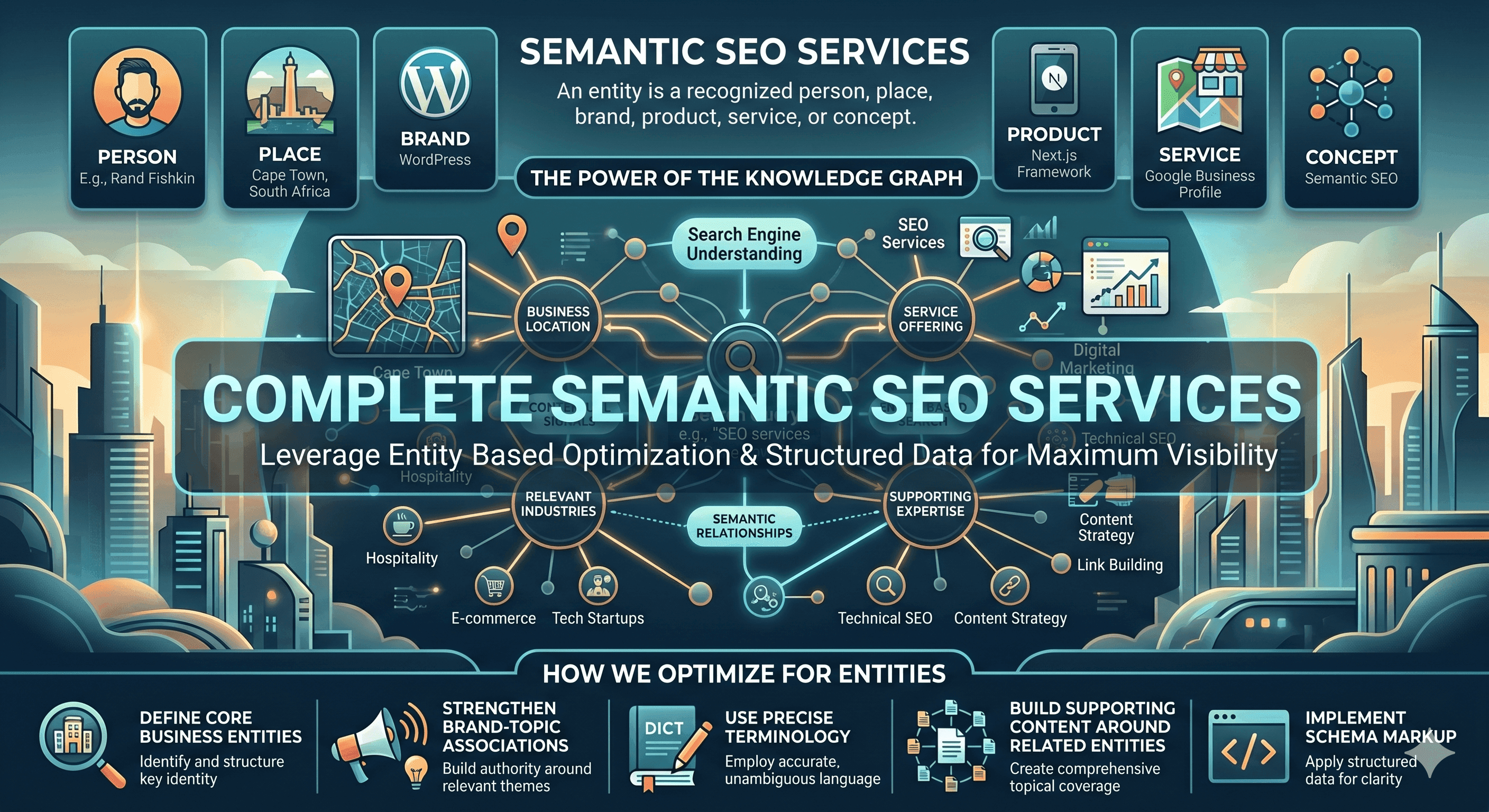
Key Takeaways
An entity is a uniquely identifiable thing — a person, place, organisation, product, or concept — that search engines store and connect in a knowledge graph, independent of the words used to describe it.
Entity SEO shifts optimisation from matching keyword strings to clarifying which real-world things your content is about and how they relate.
Google's Knowledge Graph assigns each entity a stable identifier (a machine ID), so 'Apple the company' and 'apple the fruit' are different nodes regardless of spelling.
The entity-attribute-value model is how machines represent an entity: the thing, its properties, and the values of those properties.
Disambiguation signals — consistent naming, sameAs links to Wikipedia/Wikidata, and about/mentions schema — tell search engines exactly which entity you mean.
Entity-based content architecture (a pillar plus connected supporting pages) builds the topical coverage that earns entity recognition and AI citation.
Entity optimisation is the foundation that semantic SEO, topical maps, and generative engine optimisation all build on.
What Is an Entity?
An entity is a uniquely identifiable thing that exists independently of the words used to name it. A person, a city, a company, a product, an event, or an abstract concept can all be entities. Google's own definition is precise: an entity is "a thing or concept that is singular, unique, well-defined and distinguishable."
The important shift is that entities are language-independent. The company behind the iPhone is the same entity whether you write "Apple," "Apple Inc.," or "the maker of the iPhone." A search engine that understands entities can connect all three phrases to a single node — and keep that node separate from the fruit of the same name.
This is the "strings to things" shift that underpins modern search. For the broader context, see what semantic SEO is and how to apply it.
Entities vs. Keywords
Keyword optimisation and entity optimisation answer different questions. A keyword tells the engine which words appear on a page. An entity tells the engine which real-world thing the page is genuinely about — and crucially, removes ambiguity.
Keyword
The string "jaguar speed". Ambiguous on its own — the engine cannot tell whether you mean the animal, the car, or the team.
Entity
Jaguar (Panthera onca) — a node with attributes (top speed, habitat, conservation status) and relationships (big cats, the Americas).
You do not abandon keywords — they remain how you discover what your audience asks. But you map those keywords onto the entities they reference, and then build content that makes those entities and their relationships explicit.
The Entity-Attribute-Value Model
Machines represent entities using the entity-attribute-value (EAV) model: the thing, one of its properties, and the value of that property. Search engines accumulate millions of these triples to build a structured picture of each entity.
| Entity | Attribute | Value |
|---|---|---|
| Cape Town | country | South Africa |
| Cape Town | famous landmark | Table Mountain |
| Table Mountain | type | flat-topped mountain |
Notice how values are themselves entities — South Africa, Table Mountain — which then have their own attributes. This is what makes a knowledge graph a graph: a web of connected entities, not a flat list. Your job in entity SEO is to surface these attributes and relationships so the engine can confirm and extend what it already knows.
How the Knowledge Graph Works
Google's Knowledge Graph is a database of entities and their relationships, launched in 2012 and expanded continuously since. When it recognises an entity, it assigns a stable machine identifier — so the entity persists even as the words around it change. The knowledge panels you see on the right of search results are the visible surface of this graph.
Behind a query, the engine performs entity recognition: it parses the text, links recognised mentions to graph nodes, and disambiguates between candidates using context. "Apple revenue" resolves to the company; "apple nutrition" resolves to the fruit. The same recognition runs over your pages to decide which entities you cover and how authoritatively.
The practical implication: you are not only writing for readers, you are feeding a graph. Content that confirms known attributes, adds well-supported new ones, and connects entities clearly is content the graph can absorb — and that absorption is what entity authority is built from.
How to Signal Entities to Search Engines
Recognition depends on signals. These are the levers that tell an engine exactly which entity you mean and corroborate its identity:
Use one consistent name for each entity across your site, schema, and external profiles — inconsistent naming splits the entity in the engine's understanding.
Add Organization and Person schema with sameAs links to authoritative profiles (Wikipedia, Wikidata, LinkedIn, Crunchbase) to corroborate identity.
Use the about and mentions properties in Article schema to declare the primary entity a page covers and the secondary entities it references.
Define entities explicitly in the opening passage — a clear 'X is a Y that does Z' sentence is the most extractable form for both passage ranking and AI answers.
Cover an entity's key attributes (its properties, relationships, and common questions) across connected pages so coverage is comprehensive, not shallow.
Earn unlinked brand mentions and citations from topically relevant sources — corroboration across the web strengthens an entity's authority.
Structured data is the most direct of these. A page that declares its primary entity with about, references related ones with mentions, and links identity with sameAs gives the engine an unambiguous map rather than asking it to infer one.
Entity-Based Content Architecture
Individual signals matter, but entity authority is earned at the site level. The architecture that produces it is a pillar page covering a core entity, supported by connected pages that each cover one of its attributes, questions, or related entities — all interlinked so the relationships are explicit.
This is the same structure described in the semantic SEO topical map. A topical map is, in effect, an entity map: it lays out the entities you intend to own and the relationships between them, then assigns each to a page.
Done well, this coverage compounds. Each supporting page confirms attributes of the core entity, the interlinking makes relationships crawlable, and the cluster as a whole signals that your site is a comprehensive, authoritative source on that entity — the precondition for both classic rankings and AI citation.
Entity SEO Checklist
- Identify the core entities your business is genuinely authoritative about.
- Write a clear, definitional opening sentence for each primary entity on its page.
- Implement Organization/Person schema with sameAs to Wikipedia, Wikidata, and key profiles.
- Tag each article with about (primary entity) and mentions (related entities).
- Standardise entity names everywhere — site copy, schema, social profiles, citations.
- Build a pillar page per core entity, supported by pages covering its attributes and questions.
- Interlink the cluster so the relationships between entities are explicit and crawlable.
- Pursue relevant brand mentions and links that corroborate the entity's expertise.
Frequently Asked Questions
What is the difference between a keyword and an entity?
A keyword is a string of text a user types. An entity is the real-world thing that string refers to — a person, place, product, or concept — which search engines store as a node with a stable identifier and a set of relationships. The keyword 'jaguar' is ambiguous; the entity is either the animal, the car brand, or the NFL team, each a distinct node in the Knowledge Graph.
What is the Google Knowledge Graph?
The Knowledge Graph is Google's database of entities and the relationships between them. It powers knowledge panels, disambiguation, and much of how Google understands queries. Each entity is assigned a machine identifier so the system can reason about the thing itself rather than the words used to describe it.
How do I tell Google which entity my page is about?
Define the entity clearly in your opening passage, use consistent naming, add Organization or Person schema with sameAs links to authoritative profiles such as Wikipedia and Wikidata, and use the about and mentions properties in your Article schema. Together these signals disambiguate which entity you mean and corroborate its identity.
Do I need a Wikipedia page to do entity SEO?
No. A Wikipedia or Wikidata entry strengthens an entity because it is an authoritative corroborating source, but you can build entity recognition through consistent naming, structured data with sameAs links to the profiles you do have, comprehensive topical coverage, and brand mentions from relevant sources.
Is entity SEO the same as semantic SEO?
Entity SEO is the core mechanism within semantic SEO. Semantic SEO is the broader practice of optimising for meaning, context, and topical authority; entity optimisation — making the things your content covers unambiguous and well-connected — is the foundation that the rest of semantic SEO and generative engine optimisation build on.
How does entity SEO affect AI search and AI Overviews?
AI search systems retrieve and synthesise answers around entities. Content that clearly defines entities, corroborates their identity, and covers their attributes comprehensively is easier for these systems to extract, trust, and cite — which is why entity optimisation directly supports AI Overview and AI-assistant visibility.
Conclusion
Entity SEO is the foundation the rest of modern search optimisation stands on. Once your content is organised around clearly defined, well-corroborated entities, topical maps, schema, and generative engine optimisation all become extensions of the same idea: help machines understand the things you are an authority on.
Start with the entities you genuinely know best, make them unambiguous, and build the connected coverage that proves it. That is what earns a place in the knowledge graph — and in the answers it increasingly powers.